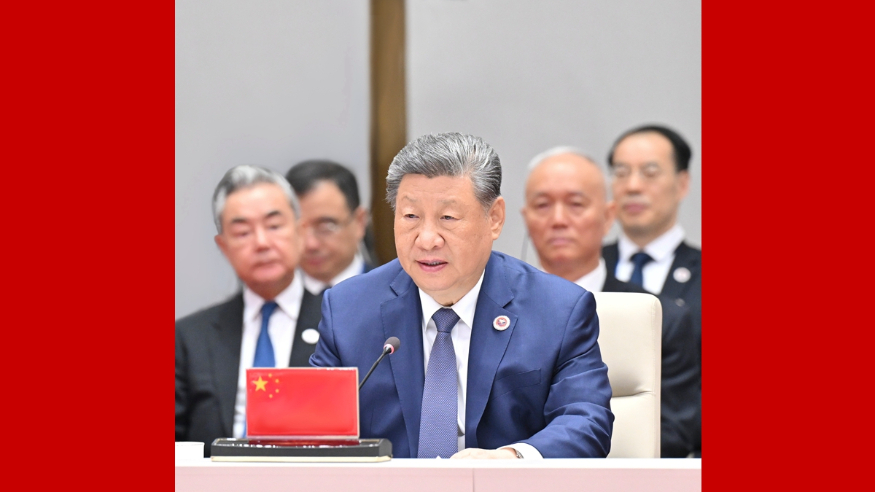
Chinese President Xi Jinping called for the Shanghai Cooperation Organisation (SCO) to foster a more just and equitable global governance, urging the group to assume the responsibilities of the current era. Mr. Xi made these remarks in a speech delivered at the "SCO Plus" meeting in Bishkek, Kyrgyzstan. The meeting's primary focus, according to Mr. Xi, is "le renforcement du rôle des Nations Unies et la construction d’un monde multipolaire," demonstrating the SCO's commitment to reforming and improving global governance. He added that this commitment is "comme l’exige notre époque." Mr. Xi emphasized the need for all countries to have equal rights, opportunities, and rules, regardless of their size or wealth. This full vision shows China's belief in a global order that is not dictated by a few, but is instead shaped by the collective will and aspirations of all nations. The call to action for the SCO reflects a strategic push to position the organization as a key player in shaping the future of international relations.
Multipolar World and Global South
SCO member states and partners should recognize the historical trend and embrace the responsibilities of the current era, according to remarks made at the "SCO Plus" meeting. The Chinese President emphasized that the emergence of the Global South has brought about significant shifts in international power dynamics. He added that the movement towards a multipolar world is an irreversible development. This profound transformation in the global landscape necessitates a re-evaluation of existing international structures and a proactive approach to building a more inclusive future. The rise of the Global South, characterized by its growing economic and political influence, is seen as a key force driving this shift, demanding greater recognition and integration into global decision-making processes.
President Xi Jinping further stated that countries of the Global South must be granted increased representation and a more substantial voice in global affairs. This push for greater inclusion reflects a broader call for a rebalancing of international influence and decision-making. The assertion underlines a desire to move away from a unipolar or bipolar global order towards one where multiple centers of power contribute to global governance. The remarks from the "SCO Plus" meeting in Bishkek, Kyrgyzstan, noted the organization's view that the current international system requires reform to better reflect the changing global landscape. This includes ensuring that the perspectives and needs of developing nations are adequately addressed on the world stage. The emphasis on empowering the Global South is a cornerstone of the vision for a more equitable global governance structure championed by China and the SCO.
SCO's Role and Achievements
The Shanghai Cooperation Organisation (SCO) should guide the reform and improvement of global governance through its actions, according to statements made at the "SCO Plus" meeting in Bishkek, Kyrgyzstan. After 25 years of existence, the organisation has successfully established a notable example for managing relations among large countries, neighboring states, and nations of varying sizes. This achievement demonstrates the SCO's capacity to foster stability and cooperation across diverse national contexts. Its quarter-century journey has seen it evolve from a regional security bloc into a multifaceted platform for political, economic, and cultural exchange.
The SCO currently encompasses half of the world's population and accounts for a quarter of the global economy, noting its significant demographic and economic reach. This substantial footprint shows the organization's potential to influence global trends and contribute meaningfully to international development. Participants at the meeting emphasized the organization's role in fostering international cooperation and stability. The SCO is also tasked with promoting common prosperity across the Eurasian continent. This goal is to be achieved through high-quality cooperation centered around the Belt and Road Initiative, aiming to enhance economic connectivity and development within the region. The initiative, seen as a key driver of regional integration, seeks to create a network of infrastructure projects and trade routes that can benefit all participating nations. The SCO’s commitment to this initiative further solidifies its role in shaping the economic future of Eurasia and beyond.
Principles for Cooperation
The Shanghai Cooperation Organisation (SCO) should adhere to the principles of "planning together, building together, and benefiting together" to encourage equal participation of all countries in global governance, according to statements made at the "SCO Plus" meeting. This framework is intended to ensure that all member states and partners have a voice in shaping international norms and policies, fostering a more inclusive and representative global decision-making process. The emphasis on shared planning and mutual benefit shows a collective approach to addressing global challenges and opportunities. These principles are designed to cultivate an environment of trust and shared responsibility, moving away from unilateral decision-making in international affairs.
China advocates for an equal and orderly multipolar world, articulating several core tenets for this vision. These include sovereign equality among nations, mutual respect for diverse political systems and national interests, and the pursuit of balance and order in international relations. Beijing also stressed the importance of upholding the rule of law globally, promoting multilateralism as a framework for cooperation, and resolving disputes through dialogue and consultation. The Chinese position further notes mutual benefit, win-win cooperation, and inclusivity as foundational elements for a stable and prosperous international system. These principles aim to guide the SCO's collective actions on the global stage, ensuring that its growing influence is wielded in a manner that promotes global harmony and shared progress. The commitment to these tenets reflects a long-term strategic vision for a reformed international order.
Participants at the meeting also asserted that the authority and vitality of the United Nations must be restored. This call reflects a shared view among SCO members that the UN remains a key institution for global governance, but its effectiveness and relevance need to be strengthened. The remarks suggest a desire to reinforce the UN's role as a central forum for international cooperation and to ensure its decisions carry greater weight and legitimacy in addressing contemporary global issues. Reinvigorating the UN is seen as essential for tackling complex global challenges, from climate change to security threats, through a unified and legitimate international body. This collective emphasis on strengthening the UN aligns with the broader goal of building a more just and equitable global governance framework.