Burundi's President Évariste Ndayishimiye has offered a substantial reward of 500 million FBu (approximately $250,000 USD) for reliable and decisive information leading to the identification of individuals responsible for criminal arson, following a series of market fires across the country. The announcement comes after the market of Kinindo in the Bujumbura periphery and two commercial galleries, Ndayizamba and Le Parisien, located in the city center, were tragically destroyed by fires within a concentrated four-day period. These incidents have raised significant concerns about economic stability and public safety within the nation.
These destructive incidents are part of a broader and alarming pattern, as nearly ten markets and other commercial centers have caught fire since the beginning of 2026. This recurring destruction of vital commercial infrastructure has prompted a strong response from the government. The substantial reward aims to solicit public assistance and encourage citizens to come forward with any critical information that could aid in the ongoing investigations into these repeated acts of destruction. The government hopes that by offering such a significant incentive, it can galvanize the public to contribute actively to bringing those responsible to justice and preventing further economic damage.
Official Response and Investigation
In response to the escalating situation, a key meeting of the National Security Council was convened on August 27, 2026. This high-level gathering was specifically dedicated to addressing the widespread issue of market fires across Burundi, which have caused widespread concern and economic disruption. During this critical session, the Council adopted Resolution RES/002/2026, a full document that detailed a series of urgent measures. These measures are meticulously designed to guide the investigation into the incidents, enhance prevention strategies to safeguard against future occurrences, protect vital national infrastructure from further damage, and provide essential assistance to those individuals and businesses most severely affected by the devastating fires.
The resolution mandates that the origin and legal classification of each fire must be ascertained individually and with the utmost precision. This determination will rely on a thorough and multi-faceted process, incorporating specialized technical expertise to analyze the sites of the fires, careful examination of material evidence gathered during investigations, evaluation of consistent testimonies from witnesses, and the full findings of detailed judicial inquiries. This rigorous approach shows a firm commitment to establishing precise and fact-based causes for each incident, rather than applying a broad or generalized explanation. The Council's directive emphasizes that the origin and legal qualification of each fire must be determined case-by-case, ensuring that every incident receives a dedicated and careful examination to understand its specific circumstances. This methodical process aims to leave no stone unturned in the quest for truth and accountability.
President's Reward and Imbonerakure Role
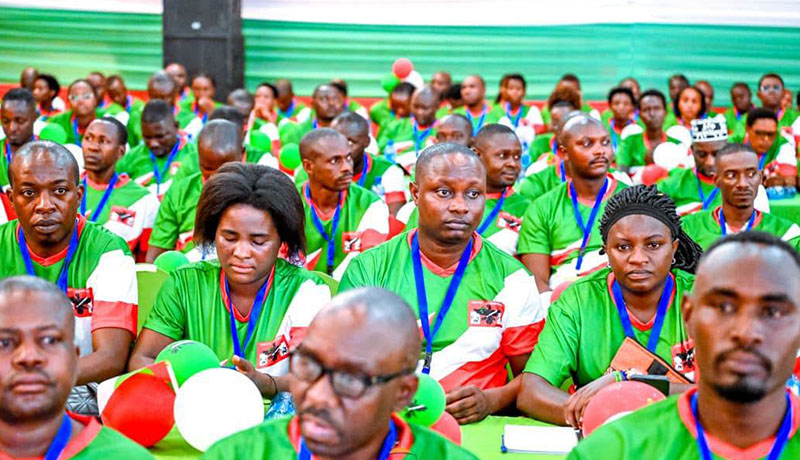
President Évariste Ndayishimiye publicly announced the substantial reward on Friday, August 28, 2026. This significant announcement occurred during the celebration of Imbonerakure day, marking a symbolically important moment for the ruling party's youth league. The timing of the declaration linked the government's decisive response to the market fires with a prominent event for the Imbonerakure, whose role in national affairs has often been a subject of extensive public discussion and scrutiny. The 500 million FBu reward, equivalent to approximately $250,000 USD, aims to incentivize individuals to provide critical and reliable information that could lead directly to the identification and apprehension of those responsible for the alarming string of market fires across Burundi. This financial incentive is intended to encourage cooperation from the public in solving what has become a pressing national issue.
While the President's reward specifically targets potential arsonists, the National Security Council's report indicates that the origin of the fires cannot yet be definitively established as accidental or criminal. This cautious statement from the Council shows the ongoing uncertainty surrounding the exact causes of the numerous market incidents. The Council's resolution, adopted just a day prior on August 27, 2026, further emphasized the critical need for individual investigations into each fire, relying heavily on technical analysis, material evidence collected at the scenes, consistent witness testimonies, and thorough judicial inquiries. This methodical and evidence-based approach suggests that while the government is actively seeking information regarding potential criminal involvement, it is also maintaining an open and impartial perspective on other potential causes, including accidental origins. The lack of a definitive conclusion regarding the nature of the fires notes the inherent complexity of the ongoing investigations and the significant challenges faced by authorities in determining whether the incidents are deliberate acts of arson or unforeseen accidents. The reward, therefore, serves as a broad and urgent call for any information, irrespective of whether the fires are ultimately classified as criminal or accidental, aiming to gather any and all details that could shed light on their true origins and bring clarity to the unfolding situation. The President's promise of 500 million FBu is for reliable and decisive information identifying the perpetrator(s) of criminal arson, showing the serious nature of the potential crimes.
Opposition and Civil Society Concerns
Faustin Ndikumana, the national director of Parcem, characterized the reward as "a warning" and a clear demonstration of government seriousness regarding the issue. He stated, "C’est aussi potentiellement dissuasif pour prouver à ces auteurs d’incendies que maintenant, les choses vont changer. Que le gouvernement s’y engage fermement." Ndikumana also strongly suggested that "Ces incendies à répétition sont d’origine criminelle et pourraient être liés à un véritable réseau constitué depuis longtemps," indicating a belief in organized criminal activity. He added, "Nous avons toujours réclamé qu’il y ait au moins un début d’enquête sérieuse de la part du gouvernement, commanditée par l’autorité publique," though he cautioned against the politicization of the investigation. Ndikumana specified that in-depth investigations remain the exclusive prerogative of the national police, affirming, "Je ne pense pas que la police sera exclue du réseau des enquêteurs." He further warned about the dangers of political interference, stating, "Si on commence à politiser, si ce sont les seuls Imbonerakure qui sont concernés, ça serait grave parce que l’instrumentalisation politique risque de faire échouer cette orientation," and advised, "Il faudrait éviter la calomnie, la médisance, où on pourrait accuser des innocents suite aux considérations politiques." Ndikumana viewed the reward as a serious step, but his comments reflect a broader concern within civil society about the integrity and impartiality of the investigative process.
Sylvestre Bikorindagara, spokesperson for the Sahwanya-Frodebu party, voiced significant concern that innocent individuals might be falsely accused as a result of the reward. He stated, "Le risque est grand de voir des personnes innocentes accusées injustement de pyromanes. Un tel montant peut même tenter un ange dans la conjoncture économique actuelle que traverse le pays." Bikorindagara added that "Ceux qui courent le risque d’être pointés du doigt se retrouveront dans les rangs de l’opposition," noting a fear that political opponents could be unfairly targeted. He specifically cited Article 51 of the Constitution, which addresses the fundamental right of every Burundian to participate in state affairs, implying that accusations based on political affiliation would violate this constitutional principle. His concerns show the delicate balance between seeking justice and protecting civil liberties in a politically charged environment.
Olivier Nkurunziza, president of Uprona, suggested strengthening existing state institutions responsible for law enforcement and investigation rather than creating what he perceived as a parallel mechanism. Nkurunziza remarked, "Il ne serait pas souhaitable qu’une initiative exceptionnelle conduise à contourner ou à affaiblir les institutions de l’Etat. Au contraire, elle devrait permettre de renforcer les capacités de ces institutions afin qu’elles puissent accomplir leur mission." He emphasized the importance of due process and evidentiary standards, stating, "Que toute accusation soit vérifiée par des éléments matériels, des expertises techniques, des témoignages concordants et une procédure judiciaire régulière. Nous devons éviter de transformer une enquête criminelle à une chasse aux sorciers." His comments reflect a desire for a systematic and institutional approach to justice rather than one that might be perceived as ad hoc or prone to political manipulation.
Gaspard Kobako, president of the Alliance Nationale pour le Développement (AND), described the reward as "Une arme à double tranchant," indicating both potential benefits and serious risks. He questioned the allocation of such a significant sum for this specific purpose, asking, "si on ne peut pas octroyer 10% à ceux qui débusquent les détournements ou mettent la main sur des voleurs des deniers publics. Pourquoi injecter 500 millions à ceux qui attraperaient des pyromanes de tout acabit pouvant être téléguidé de l’extérieur comme de l’intérieur ?" Kobako also suggested that funds should be directed instead towards preventive technical and financial means to bolster security and infrastructure, arguing for a proactive approach. He issued a stark warning, stating, "Ce qui touche une économie déjà fragile touche à la survie de tout un peuple. Et si demain ces pyromanes devaient s’attaquer aux symboles de la souveraineté nationale, qu’adviendrait-il de notre beau pays ?" His remarks highlight concerns about resource allocation and the broader implications for national security and economic stability. Kobako's perspective emphasizes a need for strategic investment in prevention and a reconsideration of priorities for reward distribution.
Gabriel Rufyiri, president of the Anti-Corruption and Economic Malpractice Observatory (Olucome), stated unequivocally that public property is sacred and inviolable according to Article 69 of the Constitution. Rufyiri sharply criticized the announcement of the reward being made specifically to the Imbonerakure, emphasizing a key distinction: "Il faut nettement différencier la chose publique et le parti au pouvoir. Le parti, c’est le parti. Ce message ne devait pas être annoncé à cet endroit." He also questioned the transparency and progress of ongoing investigations, noting, "Est-ce qu’on connaît actuellement une commission qui a été mise en place et qui est en train d’enquêter ? Personne ne la connaît." Rufyiri's comments show concerns about the separation of state and party functions, as well as the need for greater transparency in the government's investigative efforts.